Skip to main content


Contact
(877) 68-CALLJIMjimfreeman05@gmail.com19 N Yonge Street #75
Ormond Beach, FL 3217424/7 Emergency Service Available
Contact Us Online© 2024-2026 JF Roadside Service. All rights reserved.
Powered by Dolooma
© 2024-2026 JF Roadside Service. All rights reserved.
Powered by Dolooma

Car Won't Start? We Install New Batteries On-Site in Ormond Beach & Flagler County
When your car battery dies in Ormond Beach, Daytona Beach, Port Orange, New Smyrna Beach, Palm Coast, or Flagler Beach, you don't need a tow—you need a new battery installed fast. JF Roadside Service brings professional mobile battery installation to your location: driveway, workplace parking lot, grocery store, beach access point, or anywhere else you're stranded. We test your existing battery to confirm replacement is needed, remove the dead unit, install a quality replacement correctly, and dispose of the old battery responsibly. Most installations take 20-30 minutes, and you're back on the road without the hassle or expense of a tow truck. Our technicians carry the tools and expertise to handle most passenger vehicles, SUVs, and light trucks. If you already purchased a battery from an auto parts store, we'll install it for you. If you need help sourcing the right battery for your make and model, we can guide you or supply one directly. Florida's extreme heat shortens battery life—most car batteries here last 3-4 years instead of the national average of 5-6. If your battery is showing signs of failure (slow cranking, dim headlights, frequent jump starts), don't wait until you're stranded in 95-degree heat. Call JF Roadside Service at (877) 68-CALLJIM for same-day mobile battery installation anywhere in Volusia County or Flagler County.
We've installed hundreds of batteries across Volusia and Flagler County. Here's why local drivers trust us with their vehicles.
Your driveway, office parking lot, beach, or roadside—we install batteries wherever your car is located. No tow truck needed.
Our team installs batteries correctly every time—proper terminal connections, secure mounting, and system verification before we leave.
We test your battery before recommending replacement. If a jump start or terminal cleaning will get you going, we'll tell you—we don't upsell.
We know the area—from Ormond Beach to Palm Coast. Fast response times because we're based right here in the community.
When you call JF Roadside Service for battery installation, here's exactly what happens. First, we dispatch a technician to your location—usually within 30-45 minutes depending on traffic and your exact address. Upon arrival, our technician will test your existing battery with a digital load tester to confirm it has failed and cannot be revived with a charge. This step is important because sometimes the issue is a corroded terminal, loose cable, or alternator problem rather than a dead battery, and we want to solve the root cause, not just sell you a part you don't need. If the battery has indeed failed (which is the case in over 90% of calls), we'll discuss your options. If you already purchased a replacement battery from an auto parts store like AutoZone, O'Reilly, or Advance Auto Parts, we'll install it for you on the spot. If you need us to supply a battery, we can source the correct group size and Cold Cranking Amps (CCA) rating for your vehicle make, model, and year. Once the replacement battery is ready, we remove your old battery, clean the terminal posts and cable ends to ensure a solid electrical connection (corrosion buildup is extremely common in Florida's humid climate), install the new battery with proper torque on the hold-down bracket, reconnect positive and negative terminals in the correct sequence, and apply terminal protectant spray to prevent future corrosion. We then test the electrical system to verify the alternator is charging correctly and that your vehicle starts smoothly. Finally, we dispose of your old battery in compliance with EPA regulations—lead-acid batteries are classified as hazardous waste and must be recycled properly. The entire process typically takes 20-30 minutes, and you never have to leave your location or arrange a tow. Most installations can be completed on-site even if your car is in a tight parking space, though if you're in a dangerous location (like the shoulder of I-95 or US-1), we may recommend moving to a safer spot nearby before starting work.
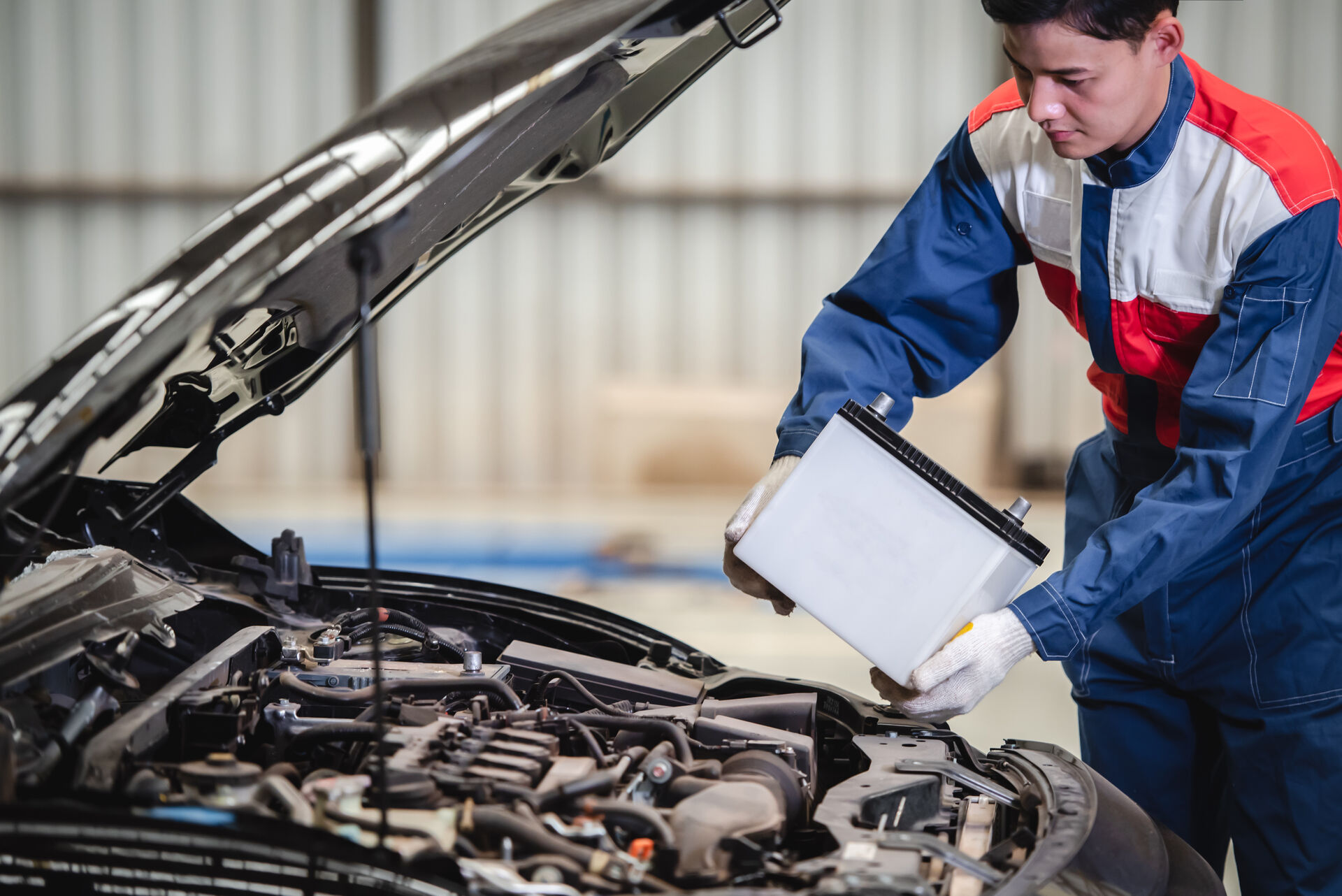
Digital battery testing to confirm replacement is needed (not just a weak charge)
Safe removal of failed battery following manufacturer disconnect sequence
Terminal and cable cleaning to remove corrosion and ensure solid connection
Professional installation of replacement battery with correct torque and mounting
Electrical system check to verify alternator charging and voltage output
Post-installation start test to confirm vehicle operates normally
Terminal protectant application to prevent future corrosion buildup
Environmentally responsible disposal of old lead-acid battery at certified recycling facility
Car batteries rarely fail without warning. If you recognize these symptoms early, you can schedule a convenient battery installation before you're stuck in a Publix parking lot or on the side of A1A. Here are the most common signs that your battery is on its last legs and needs replacement soon. **Slow Engine Cranking on Startup** — The most obvious sign of a dying battery. When you turn the key or press the start button, the engine cranks slowly—rrr-rrr-rrr—before finally turning over and starting. This happens because the battery no longer has enough cold cranking amps to spin the starter motor at full speed. It's especially noticeable on hot Florida mornings after the car has sat overnight. If you hear slow cranking, your battery likely has less than 20% capacity remaining and will fail completely within days or weeks. **Repeated Jump Starts** — Needing a jump start once might be a fluke (maybe you left interior lights on overnight). Needing jump starts two or three times in the same month? That's a failing battery. Each time you jump start the car, the alternator recharges the battery somewhat, but if the battery cells are damaged or sulfated, they can't hold a charge anymore. You're essentially running on borrowed time. Rather than keep jumper cables in your trunk and rely on the kindness of strangers, call JF Roadside Service and let us install a new battery that will actually hold a charge. **Dashboard Battery Warning Light** — That little red battery icon on your instrument cluster isn't just decorative. When it illuminates while driving (not just during the initial key-on self-test), it means your charging system has detected a problem—either the alternator isn't charging, or the battery voltage has dropped below acceptable levels. Sometimes the issue is a failing alternator rather than the battery itself, which is why we always test both components before recommending a solution. Ignoring this warning light can leave you stranded, or worse, cause you to lose power steering and brakes while driving if the battery dies completely. **Dim or Flickering Headlights** — When your battery is weak, your headlights dim noticeably when you're idling at a stoplight, then brighten when you accelerate and the alternator kicks in. You might also notice interior lights dimming, or the radio cutting out momentarily. This symptom indicates the battery can't maintain steady voltage output to your vehicle's electrical system. It's particularly dangerous at night because dim headlights reduce your visibility and make it harder for other drivers to see you, especially on unlit roads like parts of Old Dixie Highway or Tomoka Farms Road. **Electrical Accessories Acting Strange** — Modern vehicles have dozens of electronic modules controlling everything from power windows to infotainment systems. A weak battery can cause bizarre electrical gremlins: power windows moving sluggishly, radio presets getting erased, dashboard warning lights flickering randomly, or the check engine light coming on intermittently. These symptoms happen because low voltage confuses the vehicle's computer modules, causing them to throw error codes or behave unpredictably. While there can be other causes for electrical issues, a failing battery is often the root problem, and replacing it resolves the strange behavior. **Swollen or Bloated Battery Case** — Pop your hood and look at the battery. Does the plastic case look puffy or swollen, like it's been inflated? This is caused by excessive heat (extremely common in Florida where engine bay temperatures can exceed 140°F in summer) or overcharging from a faulty voltage regulator. When the battery case swells, the internal lead plates can become damaged, causing permanent capacity loss. A swollen battery should be replaced immediately—in extreme cases, overheated batteries can leak acid or even rupture. This is one situation where you shouldn't wait; call us for same-day battery installation. **Corrosion on Battery Terminals** — A little white, blue, or greenish crusty buildup around the battery posts is normal and can be cleaned off. But heavy corrosion—especially if it's accompanied by a rotten egg smell (hydrogen sulfide gas)—indicates the battery is leaking acid vapor and nearing the end of its life. Corroded terminals also create resistance, preventing the battery from delivering full power to the starter and causing the same slow-cranking symptoms mentioned earlier. We can clean terminals during a service call, but if corrosion reappears quickly after cleaning, the battery itself is likely gassing excessively and should be replaced. **Battery Age Over 3-4 Years** — Even if your battery seems fine, age matters. In Florida's heat, most car batteries last only 3-4 years compared to 5-6 years in cooler climates. Check the date code stamped on top of the battery (usually a letter and number indicating month and year of manufacture). If your battery is 4+ years old, consider proactive replacement before it fails at an inconvenient time—like when you're trying to get to work on a Monday morning or headed to the airport for a vacation flight. We've installed hundreds of batteries for Ormond Beach and Daytona Beach customers who chose convenient scheduled replacement over emergency roadside calls. **Frequent Short Trips** — This isn't a symptom of a bad battery, but a usage pattern that can kill an otherwise healthy battery prematurely. If you only drive 5-10 minutes at a time (like dropping kids at school or running to the grocery store), your alternator never has enough time to fully recharge the battery. Over weeks and months, the battery slowly discharges, sulfation builds up on the lead plates, and capacity decreases permanently. Combined with Florida heat, this usage pattern can reduce battery life to 2-3 years. If this describes your driving habits and your battery is struggling, replacement is likely overdue. If you're experiencing any of these symptoms in Ormond Beach, Daytona Beach, Port Orange, New Smyrna Beach, Palm Coast, or Flagler Beach, don't gamble on 'just one more start.' Call JF Roadside Service at (877) 68-CALLJIM, and we'll test your battery on-site and install a replacement if needed—before you're stuck with a no-start situation in 90-degree heat or a sudden afternoon thunderstorm.
No driving to AutoZone, waiting in line, buying the battery, driving home, finding tools, watching YouTube videos, and wrestling with corroded bolts. We handle everything.
Driving on a failing battery risks getting stranded mid-trip or causing electrical damage. We come to you—no risk of breaking down en route to the repair shop.
Correct terminal torque, secure mounting, voltage testing, and corrosion protection—done right the first time by trained technicians, not a DIY gamble.
We haul away your old battery and recycle it legally. No toxic lead sitting in your garage or illegal dumping—we handle EPA compliance.
Not all car batteries are interchangeable. Batteries are categorized by 'group size' (physical dimensions and terminal location) and 'Cold Cranking Amps' or CCA (starting power). Installing the wrong battery can damage your vehicle's electrical system or leave you with a battery that doesn't fit the tray. **Battery Group Size** — This is a standardized code (like Group 24, Group 35, Group 48, Group 51R) that defines the battery's length, width, height, and terminal configuration. Your vehicle was designed for a specific group size, and using a different size can cause problems. For example, a Group 24 battery won't fit in a tray designed for a Group 35—it's too long. Even if you force it in, the hold-down bracket won't secure it properly, and the battery can shift during driving, potentially causing a short circuit. Most Honda and Acura vehicles use Group 51R batteries. Many Toyota and Lexus models use Group 35 or Group 24F. Ford trucks often use Group 65, while GM trucks commonly use Group 78. If you're unsure, call us with your vehicle's year, make, and model, and we'll tell you the correct group size. **Cold Cranking Amps (CCA)** — This number (like 600 CCA or 800 CCA) measures how much current the battery can deliver at 0°F for 30 seconds while maintaining at least 7.2 volts. Higher CCA means more starting power—important for large engines, diesel engines, or vehicles with lots of electrical accessories. In Florida, you might think CCA doesn't matter because it never gets to 0°F, but higher CCA also means better performance in extreme heat (which actually makes starting harder, not easier—hot engines create more internal friction and require more cranking power). We recommend matching or slightly exceeding the vehicle manufacturer's specified CCA. For example, if your owner's manual specifies 650 CCA minimum, installing a 700 CCA battery is fine. Installing a 500 CCA battery to save money? That will cause slow cranking and premature failure. Most passenger cars need 400-600 CCA, SUVs and light trucks need 600-800 CCA, and heavy-duty trucks or diesel engines need 800-1000+ CCA. **Reserve Capacity (RC)** — This is a less-discussed spec but still important. Reserve capacity measures how long the battery can run essential electrical systems (headlights, wipers, flashers) if the alternator fails, measured in minutes at 80°F while maintaining at least 10.5 volts. A battery with 120 minutes RC can run your headlights for 2 hours before dying, while a cheap battery with 60 minutes RC will die in 1 hour. This matters if you're stuck on the side of I-95 at night with your hazards on waiting for help—you want a battery with decent reserve capacity so you don't lose your lights while stranded. Most quality replacement batteries have 90-120 minutes RC. Budget batteries often have 60-80 minutes RC. **Battery Type – Flooded vs. AGM** — Traditional 'flooded' lead-acid batteries have liquid electrolyte and removable caps (though many modern ones are 'maintenance-free' with sealed tops). These are the most common and affordable. AGM (Absorbent Glass Mat) batteries use fiberglass mats soaked in electrolyte rather than liquid, making them spill-proof and more resistant to vibration. AGM batteries also charge faster, have lower self-discharge rates, and perform better in extreme temperatures. However, they cost 50-100% more than flooded batteries. If your vehicle came with an AGM battery from the factory (common on vehicles with start-stop systems, heavy electrical loads, or premium models), you should replace it with another AGM battery. Installing a flooded battery in a vehicle designed for AGM can cause premature failure because the charging system is calibrated differently. If your vehicle originally came with a flooded battery, you can upgrade to AGM for better performance and longevity, but it's not required. Still confused about what battery your car needs? Don't guess—call JF Roadside Service at (877) 68-CALLJIM. Give us your vehicle's year, make, model, and engine size, and we'll tell you exactly what battery is correct. If you're calling for mobile installation, we'll bring the right battery with us (or install one you've already purchased, if it's the correct spec).
If you moved to Florida from up north, you might be surprised how quickly car batteries die here. A battery that would last 6 years in Minnesota or Ohio will barely make it 3-4 years in Ormond Beach or Daytona Beach. The reason? Heat—lots of it. **Heat Accelerates Chemical Breakdown** — Car batteries generate electricity through chemical reactions between lead plates and sulfuric acid electrolyte. Higher temperatures speed up these reactions, which sounds good (more power!) but actually causes faster degradation of the battery's internal components. For every 15°F increase in temperature, the rate of chemical reactions inside the battery doubles. In a Florida summer, engine bay temperatures regularly exceed 140°F—that's 50-60 degrees hotter than the 80°F testing standard used for battery ratings. This extreme heat causes the electrolyte to evaporate faster, the lead plates to corrode more quickly, and the active material on the plates to shed and fall to the bottom of the battery case (a process called 'shedding'). Over time, this reduces the battery's capacity and eventually causes internal short circuits as the shed material builds up. **Frequent Short Trips Prevent Full Recharge** — Florida's sprawling suburban layout means lots of short drives—to Publix, to the bank, to drop kids at school. These 5-10 minute trips are terrible for batteries because the alternator needs 20-30 minutes of highway driving to fully recharge a battery after the heavy starting load. When you repeatedly start the engine without giving the alternator time to recharge, the battery slowly discharges over days and weeks. This leads to sulfation—hard crystals forming on the lead plates that permanently reduce capacity. Combined with heat, frequent short-trip driving can kill a battery in 2 years. **Florida Humidity Accelerates Corrosion** — You've probably noticed white or greenish crusty buildup on battery terminals. That's corrosion caused by battery acid vapor reacting with the metal terminals in the presence of moisture. Florida's 70-90% humidity accelerates this process dramatically compared to dry climates. Heavy corrosion creates electrical resistance, preventing the battery from delivering full power to the starter. It can also cause voltage drops that confuse your vehicle's computer modules, triggering check engine lights or other electrical gremlins. While corrosion can be cleaned, its rapid reappearance is a sign the battery is leaking acid vapor—an indication of internal damage and impending failure. **Air Conditioning Load Strains the Battery** — Running the AC in a Florida summer isn't optional—it's a survival necessity. But the AC compressor, blower motor, and cooling fans put a constant electrical load on the battery and alternator. If you're sitting in traffic on I-95 or US-1 with the AC blasting, engine idling, and maybe charging your phone and running the radio, your alternator is working overtime to keep up. An older battery with reduced capacity struggles to buffer these electrical loads, leading to voltage fluctuations and faster degradation. This is why batteries often fail during summer months—the combination of heat and electrical load is a one-two punch. **Vehicle Sits for Extended Periods** — If you're a snowbird who leaves your car parked for months during summer or winter, your battery will suffer. All batteries self-discharge over time (about 3-5% per month for a healthy flooded battery, less for AGM). In hot weather, self-discharge accelerates—a battery sitting in a 100°F garage can lose 10-15% of its charge per month. Meanwhile, computers and security systems in modern vehicles draw a small 'parasitic' load even when the car is off (typically 30-50 milliamps, but sometimes more if there's a faulty module or glove box light staying on). After 3-4 months of sitting, the battery can drop below 50% charge, causing permanent sulfation damage. When you try to start the car after months away, you're often greeted with a dead battery that won't hold a charge even after jump starting. If you store a vehicle long-term in Ormond Beach or Daytona Beach, use a battery maintainer (trickle charger) or disconnect the negative terminal to prevent discharge. The bottom line: if your car battery is 3+ years old in Florida, it's on borrowed time. Don't wait for a no-start emergency in a Walmart parking lot at 2 PM when it's 95 degrees outside. Call JF Roadside Service at (877) 68-CALLJIM for proactive battery testing and replacement before you're stuck.
JF Roadside Service provides mobile battery installation throughout our entire service territory. No matter where you're located in Volusia County or Flagler County, we'll bring professional battery replacement to your door. Here's a detailed breakdown of our service coverage. **Ormond Beach Battery Installation** — Whether you're in the beachside neighborhoods off A1A, the mainland residential areas near Granada Boulevard and Nova Road, the Central Park area, Plantation Oaks, or the northern sections near Tomoka State Park, we provide fast mobile battery installation anywhere in Ormond Beach. Common call locations include the Lowe's and Target shopping centers on West Granada, the Publix on North US-1, the Ormond Towne Square shopping area, residential streets throughout the city, and even the beach parking areas along A1A where dead batteries frequently strand beachgoers. We've installed hundreds of batteries in Ormond Beach driveways, workplace parking lots, and roadside locations. If you're stuck at home, at work, or anywhere else in Ormond Beach, we'll be there within 30-45 minutes on average. **Daytona Beach Battery Installation** — Our service covers all of Daytona Beach from the International Speedway Boulevard tourist corridor to the residential neighborhoods of Indigo, from the beachside areas along Atlantic Avenue to the mainland sections off Clyde Morris Boulevard and Ridgewood Avenue. We frequently respond to battery calls at Daytona International Speedway during events (though traffic can delay arrival times during race weekends), the Daytona Beach International Airport cell phone lot (popular spot for dead batteries), Volusia Mall, One Daytona shopping district, Tanger Outlets, and the hundreds of hotels lining A1A. We also service Port Orange and South Daytona—technically separate cities but part of the greater Daytona Beach metro area. If you're stuck in a Winn-Dixie parking lot on Dunlawton Avenue, a CVS on LPGA Boulevard, or your driveway in Pelican Bay or Venetian Bay, we'll install your battery on-site. **Port Orange Battery Installation** — Port Orange has some of the highest call volumes for battery service because of the city's large residential population and numerous shopping centers. We serve every neighborhood in Port Orange: Harbor Village, Cypress Head, Crane Lakes, Countryside, Spruce Creek (including the fly-in community), the new developments off Williamson Boulevard, and the older neighborhoods near City Center and Dunlawton Avenue. Common service locations include the Pavilion at Port Orange shopping center, the Publix at Port Orange Crossing, Lowe's on Taylor Road, and countless residential driveways throughout the city. Port Orange residents appreciate our fast response times—because we're local to the area, we can often arrive in 20-30 minutes even during afternoon traffic on Dunlawton or Taylor Road. **New Smyrna Beach Battery Installation** — We provide battery installation throughout New Smyrna Beach including the beachside area across the Coronado Causeway and North Causeway bridges, the canal-front neighborhoods off Riverside Drive, the mainland residential sections near SR-44 and US-1, and the southern areas toward Edgewater. Common call locations include the Publix on SR-44, CVS on Canal Street, Flagler Avenue beachside (where tourists often leave lights on and drain batteries), the dozens of seafood restaurants along Riverside Drive, and residential neighborhoods throughout the city. NSB's beach access points are frequent dead-battery locations—visitors unfamiliar with the parking areas sometimes leave accessories running while at the beach, returning hours later to a dead battery. We also service Oak Hill, the small community south of New Smyrna Beach—while it's a bit farther, we still respond to calls there. **Edgewater Battery Installation** — Edgewater is part of our core service area. We install batteries throughout the city including the residential areas off Indian River Boulevard and Riverside Drive, the commercial corridor along US-1, and the neighborhoods near Hawks Park and Menard-May Park. Edgewater's proximity to New Smyrna Beach means we often serve both cities on the same day. If you're stuck at home in Edgewater or at one of the shopping plazas along US-1, we'll install your battery on-site. **Palm Coast Battery Installation** — Palm Coast's large geographic size and sprawling residential layout means we respond to battery calls all over the city: the F-Section neighborhoods (Florida Park Drive and side streets), the P-Section (Palm Coast Parkway and surrounding areas), the C-Section (Club House Drive area), the E-Section (east of US-1), Grand Haven, Island Walk, and the Town Center area. Common call locations include the Publix stores on Palm Coast Parkway and Old Kings Road, the Walmart and Target shopping centers, Palm Coast Landing (the outdoor mall), and hundreds of residential driveways throughout the city's dozens of neighborhoods. Palm Coast is about 30 minutes north of Ormond Beach, so our arrival times there are typically 35-50 minutes depending on your exact location and traffic on I-95 or US-1. **Flagler Beach Battery Installation** — We service all of Flagler Beach including the beachside neighborhoods off A1A, the mainland areas near the Hammock, and the residential sections along John Anderson Highway. Flagler Beach is a smaller city, so we know it well—from the iconic Flagler Beach Pier to the state parks on either end of town. If your battery dies at one of the beach access parking areas, at a restaurant along A1A, or at home in a residential neighborhood, we'll install a new battery on-site. Flagler Beach is about 20-25 minutes north of Ormond Beach, so our typical arrival time is 30-40 minutes. **Volusia County Wide Service** — Beyond the major cities, we also respond to battery installation calls in smaller communities throughout Volusia County: DeLand (the county seat), DeBary, Deltona, Orange City, Lake Helen, Pierson, and everywhere in between. If you're stuck on I-95, I-4, US-1, SR-40, or any other major road in Volusia County and need a battery installed, we'll dispatch a technician to your location. We do ask that you move to a safe parking area if possible—we cannot install batteries on the shoulder of I-95 or I-4 due to safety regulations, but we can meet you at the next exit rest area or gas station. **Flagler County Wide Service** — In addition to Palm Coast and Flagler Beach, we serve the rest of Flagler County including Bunnell (the county seat), the Hammock area, Beverly Beach, and Marineland. Flagler County is less densely populated than Volusia County, so response times can be slightly longer (40-60 minutes in some cases), but we still provide the same professional on-site battery installation service. No matter where you are in Volusia County or Flagler County—your driveway, your workplace, a shopping center, a restaurant parking lot, a beach access point, or a safe roadside location—JF Roadside Service will bring mobile battery installation to you. Call (877) 68-CALLJIM and let us know where you're stranded, and we'll dispatch a technician with the right battery for your vehicle.
We can do either. If you already purchased a battery from AutoZone, O'Reilly, Advance Auto Parts, or another retailer, we'll install it for you—just make sure you bought the correct group size and CCA rating for your vehicle. If you haven't purchased a battery yet, we can source the correct battery for your make and model and bring it with us. Call us with your vehicle's year, make, model, and engine size, and we'll tell you what battery you need and provide a quote for supply and installation. Many customers prefer we supply the battery because it eliminates the guesswork about size and specs, and they don't have to make a separate trip to the auto parts store.
Most battery installations take 20-30 minutes from start to finish. This includes testing the old battery to confirm replacement is needed, removing it, cleaning corroded terminals and cable ends, installing the new battery with proper torque on hold-down brackets and terminal bolts, applying terminal protectant spray, testing the electrical system and alternator output, and verifying the vehicle starts properly. Some vehicles have batteries in difficult locations (under the rear seat, in the trunk, or under the windshield cowl) which can add 10-15 minutes, but the vast majority of passenger cars, SUVs, and trucks have batteries in the engine bay and are straightforward to replace. Add another 10-15 minutes for our technician to arrive after you call, assuming we're already on the road in your area.
We take your old battery with us and dispose of it at a certified lead-acid battery recycling facility in compliance with EPA regulations. Car batteries contain lead (a toxic heavy metal) and sulfuric acid (a corrosive hazardous material), so they cannot be thrown in regular trash—it's actually illegal to do so in Florida. Responsible disposal means the lead is recovered and recycled into new batteries, and the plastic case and acid are processed separately. You don't have to worry about storing a toxic battery in your garage or making a trip to a hazmat disposal site—we handle everything.
Yes. Vehicles with start-stop systems (where the engine automatically shuts off at stoplights to save fuel, then restarts when you lift off the brake) require either an Enhanced Flooded Battery (EFB) or an AGM battery. These batteries are designed to handle the high number of start cycles (a start-stop vehicle can have 10-20x more engine starts per year than a traditional vehicle) and the deep discharge cycles caused by running electrical accessories with the engine off. Installing a standard flooded battery in a start-stop vehicle will cause premature failure—often in less than a year. AGM batteries are the most common replacement for start-stop vehicles because they perform better and last longer, though they do cost more. When you call us, let us know your vehicle has start-stop, and we'll source the correct battery type.
Yes, in most cases. We carry portable tools and work lights, so we can install batteries in driveways, garages, tight parking spaces, and underground parking decks as long as there's enough room for our technician to open the hood and access the battery. The only locations we cannot service are unsafe roadside positions like the shoulder of I-95 or other high-speed roads—in those cases, we'll ask you to drive or be towed to the next exit or safe parking area (a gas station, rest area, or shopping center parking lot) where we can meet you. If your battery is completely dead and the car won't move, we can sometimes arrange a quick tow to a nearby safe location, then install the battery there.
Pricing depends on whether you're supplying the battery yourself (in which case we charge a labor-only installation fee) or if you need us to supply the battery (in which case the total includes both the battery cost and installation). Battery prices vary widely based on group size, CCA rating, and whether it's a standard flooded battery or a premium AGM battery—typical retail prices range from $100-$150 for a basic flooded battery to $200-$350 for an AGM battery. Labor for mobile installation is typically $50-$80 depending on your location and the complexity of the install. Call us at (877) 68-CALLJIM for an exact quote—give us your vehicle's year, make, and model, and whether you already have a battery or need us to supply one, and we'll provide transparent pricing over the phone before dispatching a technician.
Florida's extreme heat shortens battery life significantly. A battery that would last 5-6 years in a cooler northern climate often dies in 3-4 years in Florida—sometimes even sooner if it's a lower-quality battery or the vehicle is used primarily for short trips (which prevents the alternator from fully recharging the battery). Heat accelerates the chemical reactions inside the battery, causing faster degradation of the lead plates and evaporation of the electrolyte. If your 2-year-old battery has failed, it's likely a combination of heat stress, frequent short trips, or a manufacturing defect. In some cases, a failing alternator overcharging the battery can also kill a young battery prematurely. When we test your vehicle, we'll check both the battery and alternator to determine the root cause and prevent it from happening again.
Still have questions? Contact us
Don't wait for a tow truck or drive on a failing battery. JF Roadside Service brings professional mobile battery installation to your location anywhere in Ormond Beach, Daytona Beach, Port Orange, New Smyrna Beach, Palm Coast, or Flagler Beach. Same-day service, honest diagnostics, proper installation, and responsible disposal. Call us now and get back on the road fast.